
Hiking Trail Signs and Symbols Meaning – Blazes, Colors and Warnings
Hiking trail signs and symbols help you navigate safely and avoid getting lost. Learning the meaning of trail markers, warning signs, and blaze symbols is an essential skill for every beginner hiker. In this guide, you’ll learn how to read hiking trail signs, understand trail symbols, and follow markers with confidence.
This table explains the meaning of hiking trail signs and symbols you will see on the trail.
| Sign Type / Symbol | Meaning | Where You See It | Tip for Hikers |
|---|---|---|---|
| Trailhead Sign | Shows trail name, difficulty, distance, and map | Beginning of trails | Study it before starting your hike |
| Directional Sign | Arrow pointing toward destination | Trail junctions | Confirm direction before choosing path |
| Warning Sign | Hazard ahead (steep drop, wildlife, slippery terrain) | Dangerous areas | Slow down and stay alert |
| Informational Sign | Educational or safety info about wildlife, geology, or history | Along trails | Read carefully to enhance hiking experience |
| Painted Blaze | Color-coded marks on trees or rocks | Throughout trail | Single = straight, double = turn ahead |
| Cairn | Stacked stones marking trail | Rocky or treeless areas | Follow next cairn to stay on path |
| Carved/Reflective Marker | Symbols or numbers on posts or trees | Low-light areas | Helps confirm location and route |
| Tent Symbol | Camping area or campground | Trail maps or trailheads | Only camp in designated areas |
| Water Drop Symbol | Water source | Near springs or fountains | Carry extra water if needed |
| Exclamation Mark | General caution / danger | Hazard zones | Always read and follow instructions |
| Bear Symbol | Bear country warning | High wildlife activity areas | Keep distance, secure food |
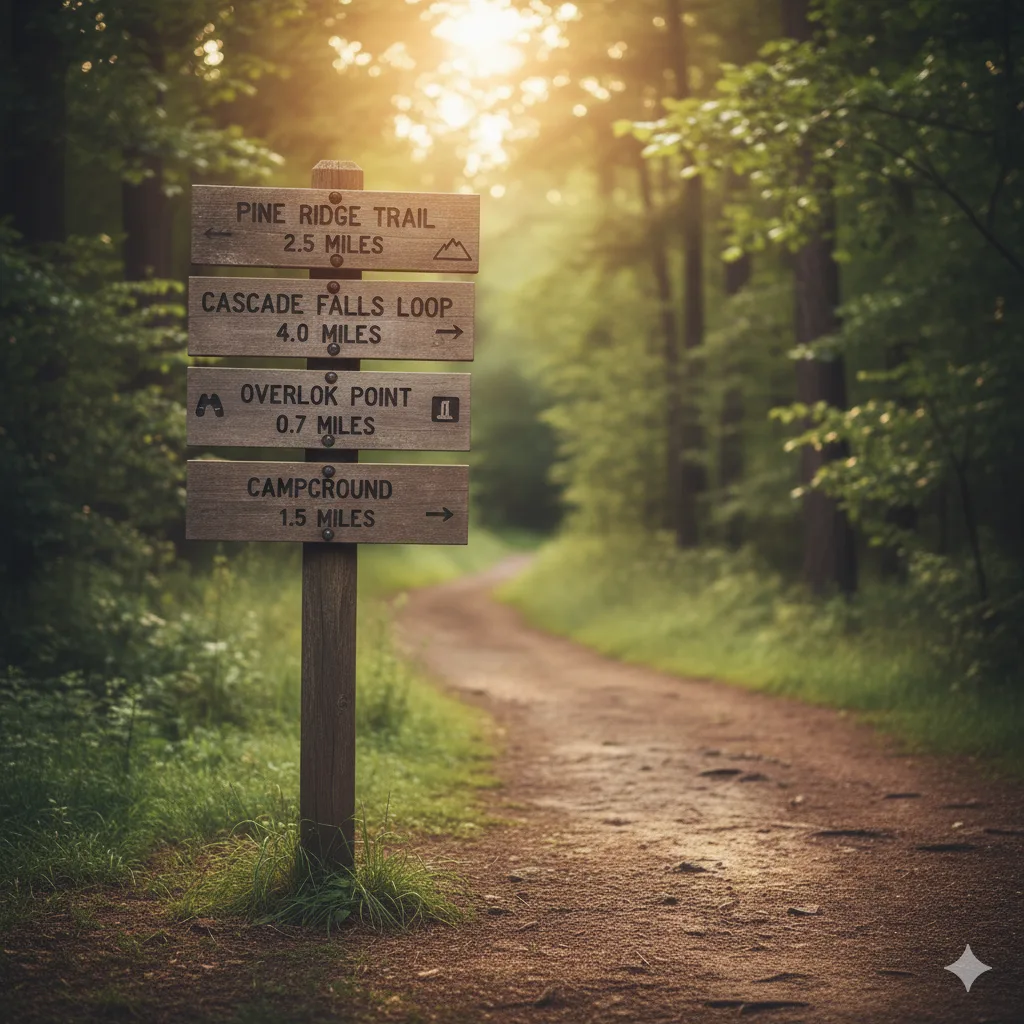
Why Trail Signs Matter
Understanding trail signage is a fundamental hiking skill. Without it, even a well-planned hike can go wrong quickly. Trail signs confirm you are on the correct path, provide distance and time estimates, and alert you to hazards or conditions ahead. They also indicate nearby services like water sources, rest areas, and facilities all information that helps you plan your pace and make smarter decisions throughout your journey.
Types of Hiking Trail Signs and Symbols for Beginners
Different signs serve specific purposes on the trail. Recognizing each type helps you extract the right information quickly.
Trailhead Signs
These large signs appear at the beginning of trails and are your most important information source before you take a single step. A typical trailhead sign shows the trail name, difficulty rating, total distance to key destinations, elevation gain profile, and an estimated hiking time. It also includes a map overview of the trail network, the rules and regulations for that area, and emergency contact information. Always spend a few minutes studying the trailhead sign it gives you the full picture of what lies ahead.
Directional Signs
Found at trail junctions, directional signs point you toward different destinations so you can choose the correct path with confidence. They show an arrow pointing in the direction of travel, the destination name, and the distance remaining in miles or kilometers. Some directional signs also include elevation change information or list multiple destinations at once, which is especially helpful at complex junctions where several trails converge.
Informational Signs
These signs appear along the trail and provide educational content or important notices about the area you are hiking through. You will find historical information about the land, wildlife and plant identification guides, explanations of geological features, and conservation messages. Reading informational signs adds context to what you see around you and often reveals details that make the hike more memorable.
Common Hiking Warning Signs on Trails
Warning signs alert you to hazards or special conditions requiring extra caution. They cover a wide range of situations including dangerous terrain ahead, wildlife warnings for bears or snakes, weather-related hazards like lightning risk zones, trail closures or access restrictions, and water crossing conditions. Always stop and read warning signs in full never assume you already know what they say.
For more navigation tips, read our essential hiking safety guide.
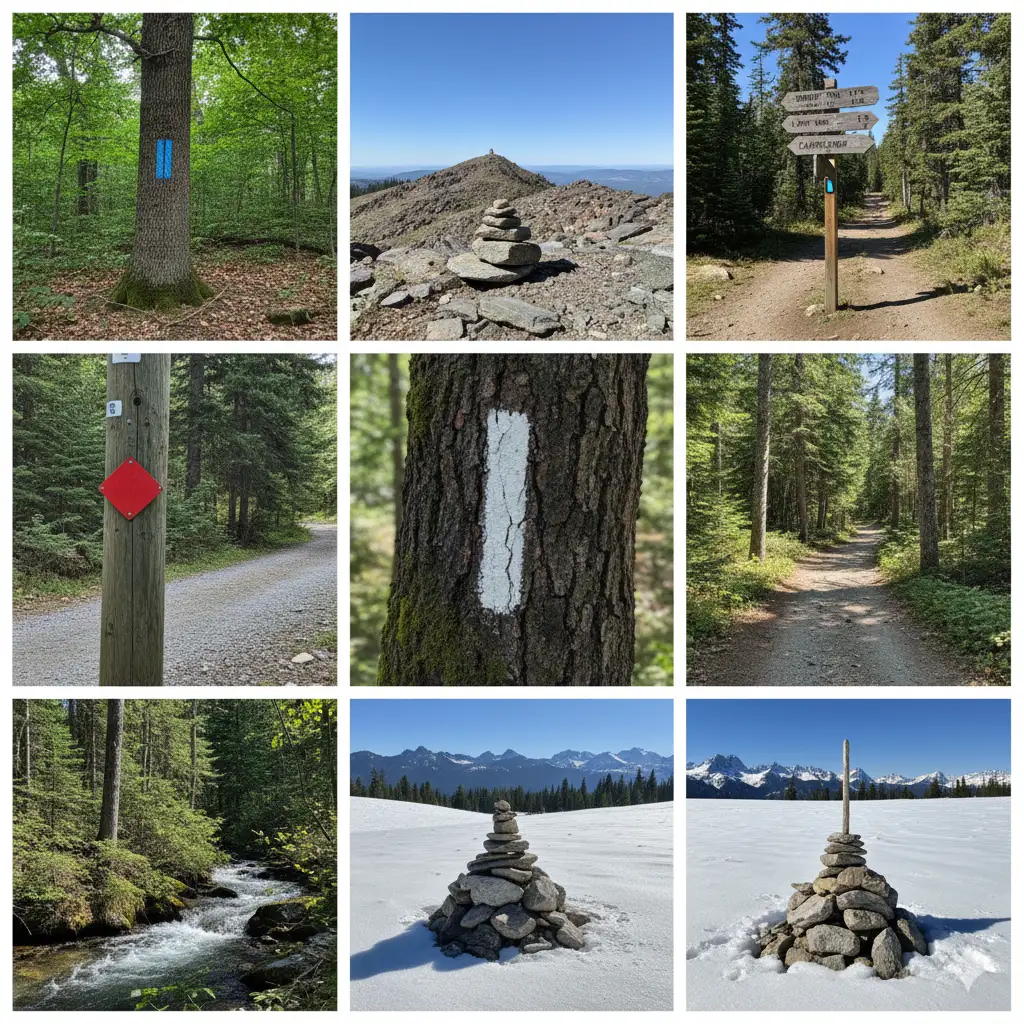
Trail Blaze Symbols, Colors, and Trail Markers Meaning Explained
Blazes are painted marks or physical markers that indicate the trail route. Different systems exist across regions and trail networks, so understanding how they work before you hike is essential.
Painted Blazes
Painted blazes are rectangular paint marks applied directly to trees or rocks along the trail, typically 2 inches wide by 6 inches tall. Each trail is assigned its own color so hikers can distinguish one route from another at junctions. A single blaze means continue straight ahead. A double blaze two rectangles stacked on top of each other warns that a turn or junction is coming up. When the top blaze is offset to the left or right, it indicates the direction of the upcoming turn.
Hiking Trail Blaze Color Meanings – Complete Color Code Guide
Trail blaze colors are not universal they vary by trail system and region. However, the table below covers the most widely used color codes you will encounter across the United States and internationally.
| Blaze Color | Common Meaning | Notable Example | What Hikers Should Know |
|---|---|---|---|
| White | Primary or long-distance trail | Appalachian Trail (AT) | Most recognized trail color in the eastern US follow white for the main AT route |
| Blue | Side trail, water source, or shelter spur | AT shelter approach trails | Blue blazes often lead to water or campsites worth following when you need them |
| Yellow | Secondary trail or connector | Various state and national parks | In some systems yellow marks the moderate-difficulty route; always check trailhead signage |
| Red | Difficult trail or loop connector | Many New England trail systems | Red sometimes signals harder terrain treat as a difficulty warning in unfamiliar parks |
| Orange | Boundary marker or caution route | National Forest boundaries | Orange blazes on property boundaries mean you are at the edge of a managed area |
| Green | Easy or nature trail | State park interpretive trails | Green is widely used for family-friendly or educational nature walks |
| Black | Expert or wilderness route | Technical backcountry trails | Rare in painted blazes; more often used on signage to indicate most difficult rating |
| Pink / Purple | Property lines or survey markers | Logging and private land boundaries | Not a hiking trail pink or purple blazes mark land survey lines, not routes |
Important: Always check the trailhead map before relying on color codes. The same color can mean different things in different trail systems.
Cairns
Cairns are deliberately stacked piles of stones used to mark the trail in areas where painting blazes on trees is not possible typically above the treeline, across rocky fields, or in alpine terrain. When following cairns, always locate the next one before moving forward. Never knock down existing cairns or build new ones, as this confuses other hikers and can lead people off the correct route.
Carved Markers
Carved markers include symbols or letters cut directly into trees, as well as metal or plastic tags nailed to trunks and numbered posts placed along the trail. Many systems also use reflective markers that catch headlamp or flashlight beams, making them especially useful for low-light conditions during early morning starts or late finishes.
How to Read Trail Markers Step by Step
Knowing how to read trail markers correctly prevents wrong turns and keeps you safe on any terrain. Follow this step-by-step process every time you encounter a marker on the trail.
Step 1 – Spot the Marker
Look at eye level on trees, posts, and large rocks. In open or rocky terrain above the treeline, scan ahead for cairns. Markers are typically placed so the next one is visible from the current one if you cannot see the next marker within 30 to 60 seconds of walking, stop and look around before continuing.
Step 2 – Read the Color
Each trail is assigned a specific blaze color. A single colored rectangle painted on a tree means you are on the correct path and should continue straight. Before starting any hike, note the blaze color for your trail so you can distinguish it from other overlapping trails at junctions.
Step 3 – Understand the Pattern
A single blaze means continue straight ahead you are on track. A double blaze with the top rectangle centered warns that a turn or junction is coming, so slow down and pay attention. If the top blaze is offset to the left, turn left ahead. If it is offset to the right, turn right. An X blaze means wrong way turn around immediately.
Step 4 – Confirm Before Moving On
At every junction, read all signs before choosing a path. Confirm your destination name appears on the sign, check the distance to verify you are making progress, and look for blazes on the trail you are about to take. Take a photo of the sign before walking away so you have a reference if you need to backtrack.
Step 5 – What to Do If You Lose the Markers
Stop immediately and do not keep walking hoping to find one. Look back to spot the last marker you passed, then scan 360 degrees at eye level from where you stand. Check your GPS or paper map to confirm your position. If still uncertain, backtrack to the last confirmed marker rather than guessing.
Practicing this process on easy, well-marked trails first builds the habit so it becomes automatic on more remote routes.
Understanding Distance Information
Distance markers help you track progress and estimate remaining hiking time. The first thing to check is whether the sign uses miles or kilometers, since confusing the two can significantly affect your planning. Distance shown on trail signs reflects the actual trail length not a straight-line measurement so it accounts for switchbacks and curves. The mileage shown is always from the sign’s current location to the destination, though some trails display cumulative distance from the trailhead instead. Round numbers on signs are often estimates rather than precise measurements, so treat them as guides rather than exact figures.
Time Estimates
Posted time estimates are based on an average hiking speed of around 2 miles per hour on flat terrain and may not account for elevation gain. Your actual time will vary based on your fitness level, pack weight, trail conditions, and how often you stop. A good rule of thumb is to track how long each section takes you personally, then use that data to estimate the remaining sections rather than relying on the posted figure. Always add extra time for steep sections, rest breaks, and photo stops.
Difficulty Ratings Explained
Trails are rated by difficulty to help you choose hikes that match your fitness and experience. Most systems use a color-coded scale: green for easy trails with gentle terrain, short distances, and minimal elevation gain; blue for moderate trails with some hills and noticeable elevation change; black for difficult routes with steep climbs and rough terrain; and double black for extreme conditions suited to expert hikers only.
What Affects Difficulty
The difficulty rating is shaped by several factors working together. Total elevation gain is one of the biggest contributors a trail can be long but flat and still rate as easy, while a short trail with a sharp climb rates as difficult. Terrain type matters too: loose rock, roots, and mud add difficulty even on a moderate grade. Exposure to weather, the length of the route, and any technical challenges like scrambling or stream crossings all factor into the final rating. Always read the full trail description rather than relying on the color code alone.
Learn more about difficulty in our complete difficulty levels guide.

Common Hiking Trail Symbols and What Each Icon Means
Trail signs use symbols to convey information at a glance, which is especially useful when you are moving quickly or the sign is in a language you do not read. The most common facility symbols include a tent for camping areas, a picnic table for rest spots, a restroom icon for toilet facilities, a water drop for water sources or fountains, and a P for parking areas at the trailhead. An emergency phone symbol marks contact points, a person figure indicates a hiking trail, a bicycle marks bike-friendly sections, a horse indicates equestrian access, and a dog with a leash means dogs are permitted but must be kept on leash.
Warning Symbols
Warning symbols use bold, high-contrast designs to catch your attention quickly. An exclamation point inside a triangle signals general caution or danger and requires you to read the accompanying text. A lightning bolt marks thunderstorm risk areas where you should descend immediately if a storm develops. Falling rocks symbols appear in rockfall zones where stopping is dangerous. A cliff symbol warns of a steep drop-off ahead, and a bear silhouette signals that you are in bear country where food must be stored securely and wildlife given wide distance.
How to Read Trail Signs at Junctions
Junctions are where most navigation mistakes happen, so a systematic approach is essential. Stop completely before reading anything moving while scanning signs leads to missed information. Read every sign at the junction before making a decision, not just the first one you see. Confirm your destination name appears on the sign you plan to follow, then check the distance to verify you are moving in the right direction and making progress toward your goal. Look for blazes on the trail you are about to take as a final confirmation, and take a photo of the junction sign before walking away.
If a sign is missing or unclear, stop and assess your surroundings without guessing. Look carefully for blazes on nearby trees, check your map and GPS location, and if still uncertain, backtrack to the last clear marker you passed. Never assume a path is correct just because it looks well-traveled.
Regional Variations
Trail marking systems vary significantly by location and managing organization, so researching the local system before you hike in a new area prevents confusion. In the United States, National Parks use standardized brown signs, State Parks vary by state but often use green, and National Forests use brown and white signs. Long-distance trails like the Appalachian Trail have their own specific blaze color systems white in the AT’s case that remain consistent across thousands of miles and multiple states.
Internationally, European trail networks often use colored markers or painted symbols on rocks and trees rather than rectangular blazes. Distances are given in kilometers, difficulty ratings use different scales, and symbol standards vary widely between countries. If you plan to hike abroad, download the local trail authority’s guide before your trip rather than assuming the system matches what you know.
Taking Photos of Signs
Photographing trail signs is one of the simplest and most effective navigation habits you can build. A photo of every junction sign creates a complete record of your route that you can reference on the return journey, use to describe your location in an emergency, and review when planning future hikes on the same trail. Make sure the entire sign fits in the frame and the text is readable before moving on. Take photos at every junction, not just the major ones the small intermediate signs are often the ones you forget. Do not rely solely on photos for navigation, but treat them as a reliable backup alongside your map and GPS.
How to Navigate When Trail Signs Are Damaged or Missing
Not all trails are perfectly maintained, and signs get damaged, vandalized, or go missing entirely. When this happens, your first resource is your map and compass never hike without them on unfamiliar terrain. Look for a worn footpath or footprints in the soil, which indicate where other hikers have traveled. Use a GPS device or phone app to confirm your position on the map, and follow natural features like ridgelines, valley floors, or stream banks that align with your planned route. Watch carefully for subtle trail markers you may have overlooked, such as faded blazes or small cairns hidden by vegetation.
If you are genuinely lost, stop and stay calm. Continuing to walk while uncertain only takes you further from where you need to be. Backtrack to the last confirmed marker or known location, and call for help if you remain disoriented. If darkness is approaching, stay put in a sheltered spot rather than moving in low visibility.
Prepare for navigation challenges with our guide to choosing beginner-friendly trails.
Trail Etiquette Signs
Some signs communicate rules and courtesy guidelines that keep the trail experience positive for everyone. The most common etiquette rules you will see posted include yielding to uphill hikers, staying on designated trails to protect vegetation, packing out all trash, keeping dogs on leash, camping only in designated areas, observing quiet hours where posted, and keeping a respectful distance from wildlife. These rules are not suggestions in many areas they are enforceable regulations that protect both the environment and other trail users.
Building Sign-Reading Confidence
Reading trail signs well is a skill that improves with deliberate practice. Start by studying trail maps before each hike so you know what signs to expect and where junctions should appear. Choose well-marked, popular trails for your first few hikes so you can practice reading signs frequently without the pressure of navigating difficult terrain. Take time to examine every sign you pass, even when you already know the way this builds familiarity with different sign styles and symbol systems. Asking experienced hikers about the local marking system and joining guided hikes are also excellent ways to learn quickly. After each hike, review the photos you took of signs to reinforce what you learned.
For more hiking navigation tips, check our Beginner Trail Navigation Guide and Hiking Safety Tips.
Conclusion
Reading trail signs is an essential navigation skill that keeps you safe and confident on hiking trails. Understanding different sign types, recognizing symbols, and knowing how to act at junctions prevents you from getting lost. Take time to stop and read all signs carefully, photograph them for reference, and don’t hesitate to backtrack if you’re uncertain. With practice, interpreting trail signs becomes second nature, allowing you to focus on enjoying your outdoor adventure.
Related Posts
Frequently Asked Questions
What should I do if I miss a trail sign and realize I’m on the wrong path?
Stop immediately and backtrack to the last sign or marker you definitely recognized. Don’t continue hoping you’ll find your way. Going back might feel frustrating, but it’s safer than pushing forward on an unknown route. Once back at the known location, read the sign more carefully and confirm your direction before proceeding.
Are trail distance estimates usually accurate?
Trail distances are generally accurate within 10–20%, but time estimates can vary significantly based on your fitness, pace, terrain difficulty, and weather conditions. Use distance markers to track your progress, but create your own time estimates based on how long previous sections took you. Add extra time for steep sections, breaks, and photo stops.
How often should I expect to see trail markers?
This varies greatly by trail and region. Well-maintained popular trails often have markers every 50 to 200 feet in areas where the path might be unclear. Some wilderness trails have markers much farther apart. If you haven’t seen a marker in several minutes on a marked trail, stop and verify you’re still on the correct path.
Can I rely on trail signs instead of bringing a map?
No, you should always carry a map even on well-signed trails. Signs can be damaged, vandalized, or missing, and weather can obscure them. Having a map and knowing how to use it provides essential backup navigation. Consider trail signs as helpful guidance rather than your only navigation method, especially on longer or more remote hikes.
What do the different hiking trail blaze colors mean?
Blaze colors are trail identifiers, not a universal system each trail network assigns its own color codes. That said, some colors carry widely recognized meanings in the US: white typically marks primary long-distance trails like the Appalachian Trail, blue often marks spur trails to water sources or shelters, and yellow or green commonly indicate secondary or easy routes. Always check the trailhead map first because the same color can mean different things in different parks or regions.
What does a double blaze mean on a hiking trail?
A double blaze two painted rectangles stacked on a tree is a warning that a turn or trail junction is coming up ahead. If the top blaze is shifted to the right, turn right. If the top blaze is shifted to the left, turn left. When you see a double blaze, slow down, look for the junction, and confirm your next direction before continuing. Never walk past a double blaze without identifying the turn.
What are trail markers called?
Trail markers go by several names depending on their type. Painted marks on trees or rocks are called blazes. Stacked stone piles are called cairns. Physical signs at trailheads and junctions are simply called trail signs or directional signs. Metal or plastic tags nailed to trees are called carsonite markers or trail tags. The collective term for all of these is trail markers or trail markings.
How do you read hiking trail markers when there are no signs?
When signs are absent, rely on blazes painted on trees or rocks look for rectangular paint marks at eye level. In open terrain above the treeline, follow cairns and keep the next one in sight before moving forward. Use your paper map or GPS app to confirm your position, look for a worn footpath in the vegetation, and follow natural features like ridgelines or valley floors that align with your planned route. If none of these work, backtrack to the last confirmed marker rather than guessing.
What is a trailhead sign and what information does it show?
A trailhead sign is the large information board at the starting point of a trail. It typically shows the trail name, distance, difficulty rating, elevation gain, estimated hiking time, a map of the trail network, rules and regulations for the area, and emergency contact information. Always spend a few minutes studying the trailhead sign before starting it gives you the full picture of what lies ahead and helps you plan your pace, water needs, and turnaround time.
What do hiking warning signs look like and what do they mean?
Hiking warning signs are typically diamond-shaped or rectangular boards with bold text or symbols indicating a specific hazard. Common examples include a bear silhouette (bear country secure your food), a lightning bolt (thunderstorm risk area descend immediately if a storm develops), a falling rocks symbol (rockfall zone move quickly and do not stop), a cliff symbol (steep drop-off ahead stay on the trail), and an exclamation mark inside a triangle (general caution read the accompanying text for details). Always stop and read warning signs fully rather than assuming you already know the hazard.



No comments yet. Be the first to share your thoughts.