
Water Purification for Trekking: Methods, Tips and Best Practices
Water purification for trekking removes harmful bacteria, viruses, and parasites from natural sources so you can safely refill during multi-day hikes. Unlike day hikes where you carry all your water, trekking requires collecting from streams, lakes, or springs along the route. Treating that water correctly prevents illness that can end your trek and create serious health problems far from any medical help.
Why Water Purification Matters for Trekking
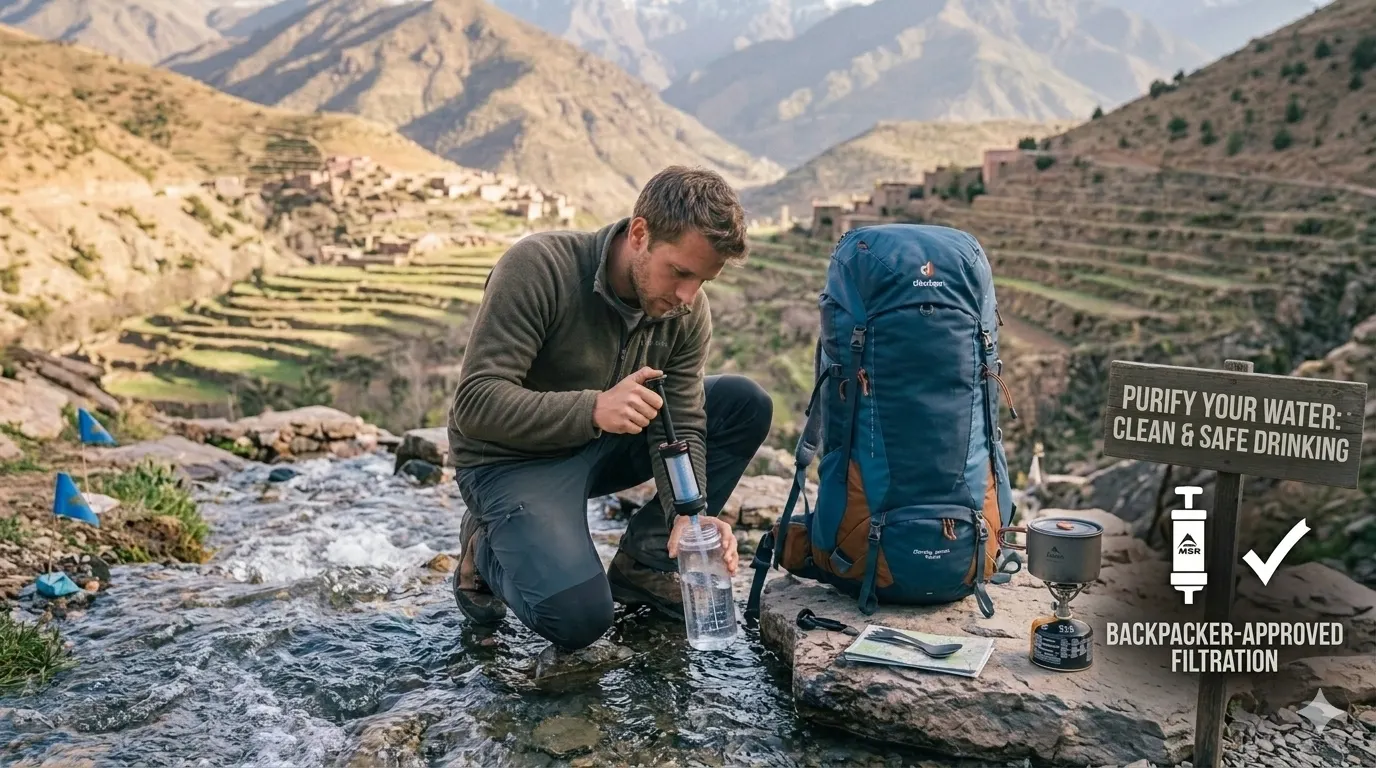
Natural water sources carry invisible threats even in the most remote wilderness. Giardia causes severe diarrhea and cramping and can take one to two weeks to show symptoms after exposure. Cryptosporidium is a parasite that resists some chemical treatments and is especially dangerous. Bacteria like E. coli enter water through animal waste upstream, and viruses — while less common in North America — are a significant risk in many international destinations.
The critical point is that clear water is not the same as safe water. Microscopic organisms are invisible, upstream wildlife contaminates water below without any visible sign, and even the most pristine-looking alpine stream can harbor parasites. The only reliable rule is to always treat your water, regardless of how remote, clean, or untouched the source appears.
Skipping treatment creates real consequences on trail: severe dehydration from diarrhea, days lost recovering in camp, potential evacuation if symptoms become serious, and long-lasting digestive problems that follow you home. The effort of treating water is negligible compared to any of those outcomes.
Water Purification Methods for Trekking
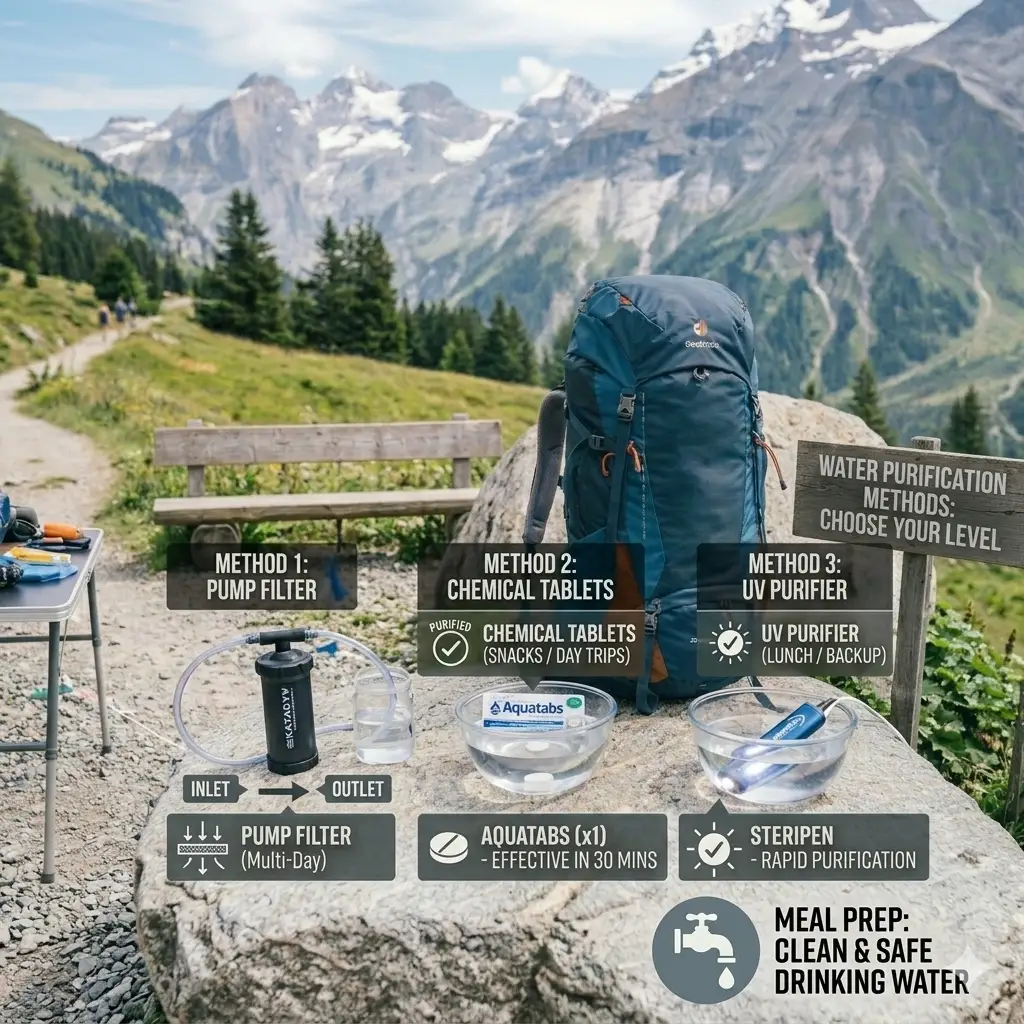
There are four main approaches to water purification for trekking, each with distinct advantages depending on your trip and destination.
Water Filters
Filters use physical barriers to remove bacteria and parasites from water. They come in several forms: pump filters require manual effort but work fast, gravity filters hang above your container and do the work for you, squeeze filters push water through an element attached to a bottle, and straw filters let you drink directly from the source. The major advantage of filters is immediacy — there is no waiting time. The key limitation is that standard filters do not remove viruses, and they can clog with dirty water or crack if they freeze in cold conditions.
Chemical Purification
Chemical tablets kill organisms through chemical reactions and are the lightest, most packable backup option available. Chlorine dioxide tablets are the strongest choice — they are effective against all threats including viruses and Cryptosporidium. Iodine tablets work against most organisms but have an unpleasant taste and should be avoided by pregnant women. The main drawback is wait time: depending on the product and water temperature, you may need to wait 30 minutes to 4 hours before drinking. Cold water extends that window considerably.
UV Light Purifiers
A UV purifier is a small pen-shaped device you stir through water for 60 to 90 seconds. The UV light destroys the DNA of bacteria, viruses, and parasites — fast, with no chemical taste, and effective against the full spectrum of threats. The limitations are that it requires charged batteries and only works in clear water. If the water is cloudy with sediment, you need to pre-filter it before UV treatment or the light cannot penetrate effectively.
Boiling Water
Boiling is the most reliable water purification method for trekking — it kills everything without requiring any equipment beyond your cooking stove. Bring water to a rolling boil for one minute at most elevations, and for three minutes above 6,500 feet where the lower boiling point requires extra time. The practical downside is that it uses fuel and takes time, making it impractical for drinking water throughout the day. It works best as a backup or for water you are already cooking with.
For complete trekking preparation guidance, check our article on how to prepare for your first trek.
Water Purification Methods Comparison for Trekking
Each water purification method for trekking has a different trade-off between protection, speed, weight, and cost. Use this table to compare them at a glance before choosing your system.
| Method | Removes Viruses | Wait Time | Weight | Best For |
|---|---|---|---|---|
| Water Filter | No | None — immediate | Light–Medium | North America, day-to-day use |
| Chlorine Dioxide Tablets | Yes | 30 min – 4 hours | Ultralight | Backup, international trekking |
| UV Purifier | Yes | 60 – 90 seconds | Light | Fast treatment, clear water |
| Boiling | Yes | 1 – 3 minutes | No extra gear | Emergency backup, cooking water |
Choosing the Right Water Purification Method
The best water purification system for trekking depends on your trip length, destination, group size, and the conditions you expect.
Weekend Treks (2–3 Days)
For short trips, a squeeze filter paired with a small supply of chemical tablets as backup covers everything you need. UV purifiers are a good alternative if you prefer technology and want fast results without taste. Keep the system simple — you do not need large capacity or advanced features for a weekend outing.
Longer Treks (4+ Days)
A gravity filter becomes the most convenient choice on longer trips because it processes large quantities of water with no manual effort — hang it while you set up camp and return to clean water. Always carry backup chemical tablets regardless of how reliable your primary system is. On very long treks, consider the filter’s lifespan and whether you may need to carry a replacement element.
Group Trekking
Gravity filters handle group water volumes efficiently and the weight can be shared across the team. Designate a water duty rotation so one person is not always responsible. Every individual should still carry personal chemical tablet backup in case the group system fails or the group splits up.
International Trekking
Outside North America and Western Europe, viruses in water sources are a genuine risk. A filter alone is not sufficient. For international trekking, the best water purification methods ranked by virus protection are: first, chlorine dioxide tablets for comprehensive chemical kill; second, a UV purifier for speed and no taste; third, boiling as a reliable no-equipment fallback. Research your specific destination before departure, since risk levels vary significantly by region and route.
How to Purify Water While Trekking: Step-by-Step
Regardless of which method you use, the process for safe water purification while trekking follows the same four core steps every time.
- Find a good source. Collect from flowing water — a moving stream is safer than a stagnant pool. Move upstream from any camping area, trail crossing, or visible animal activity before filling.
- Pre-filter if needed. If the water is cloudy or silty, pass it through a bandana, buff, or coffee filter first. Sediment clogs filters and blocks UV light from reaching pathogens.
- Apply your primary treatment. Use your filter, UV purifier, or chemical tablets according to the manufacturer’s instructions. For chemical tablets, wait the full treatment time — never cut it short.
- Prevent re-contamination. After treatment, loosen the lid and invert the bottle so treated water contacts the threads and seal. Keep clean and dirty containers separate, and never touch the clean water outlet with unwashed hands.
How to Use Your Water Purification System Correctly
Having the right gear is only half the equation. Proper technique is what makes water purification for trekking actually reliable.
General Best Practices
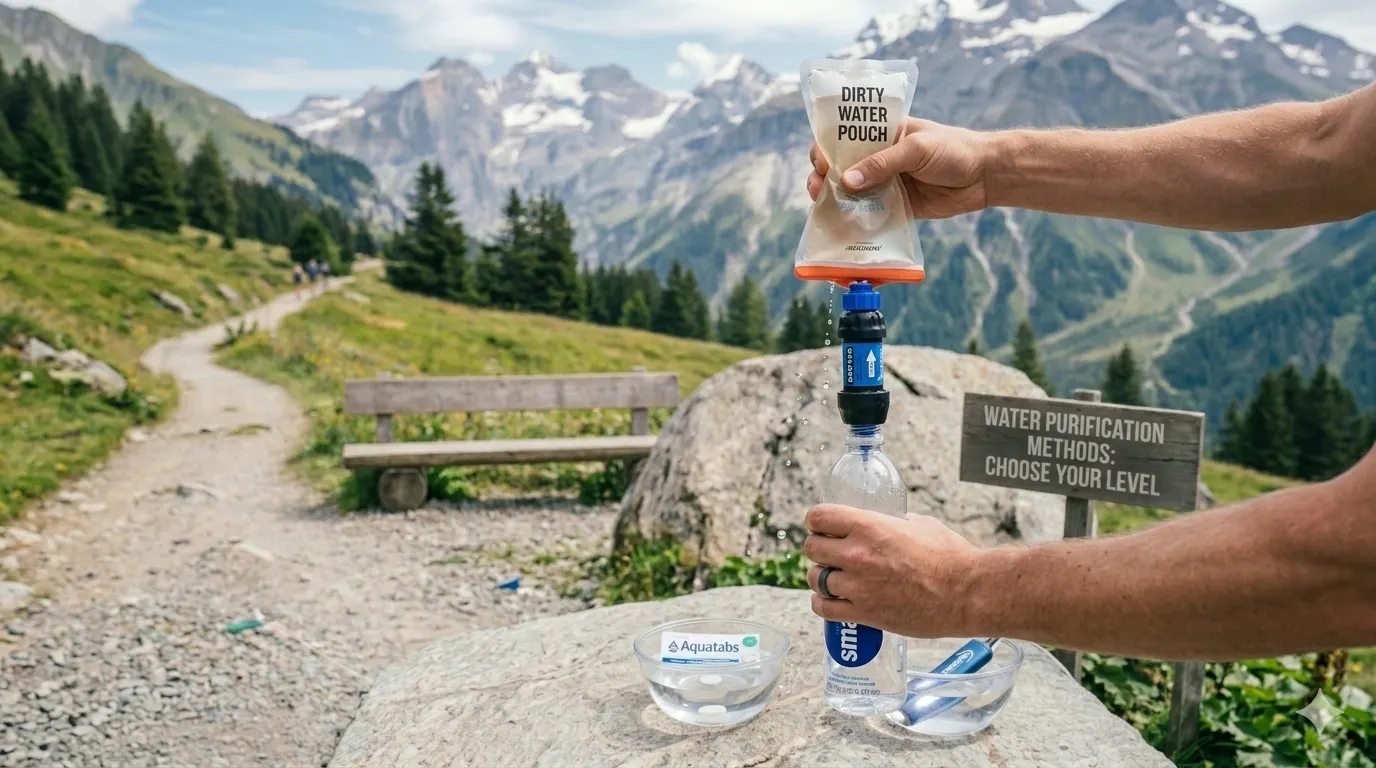
Always collect from flowing water when possible, filling from the surface rather than the bottom where sediment settles. Avoid collecting near camping areas, trails, or anywhere with visible human or animal activity. Move upstream from those points before filling. If the water is cloudy or silty, pre-filter it through a bandana or coffee filter before running it through your purification system — sediment reduces the effectiveness of both UV and chemical methods.
Using a Filter
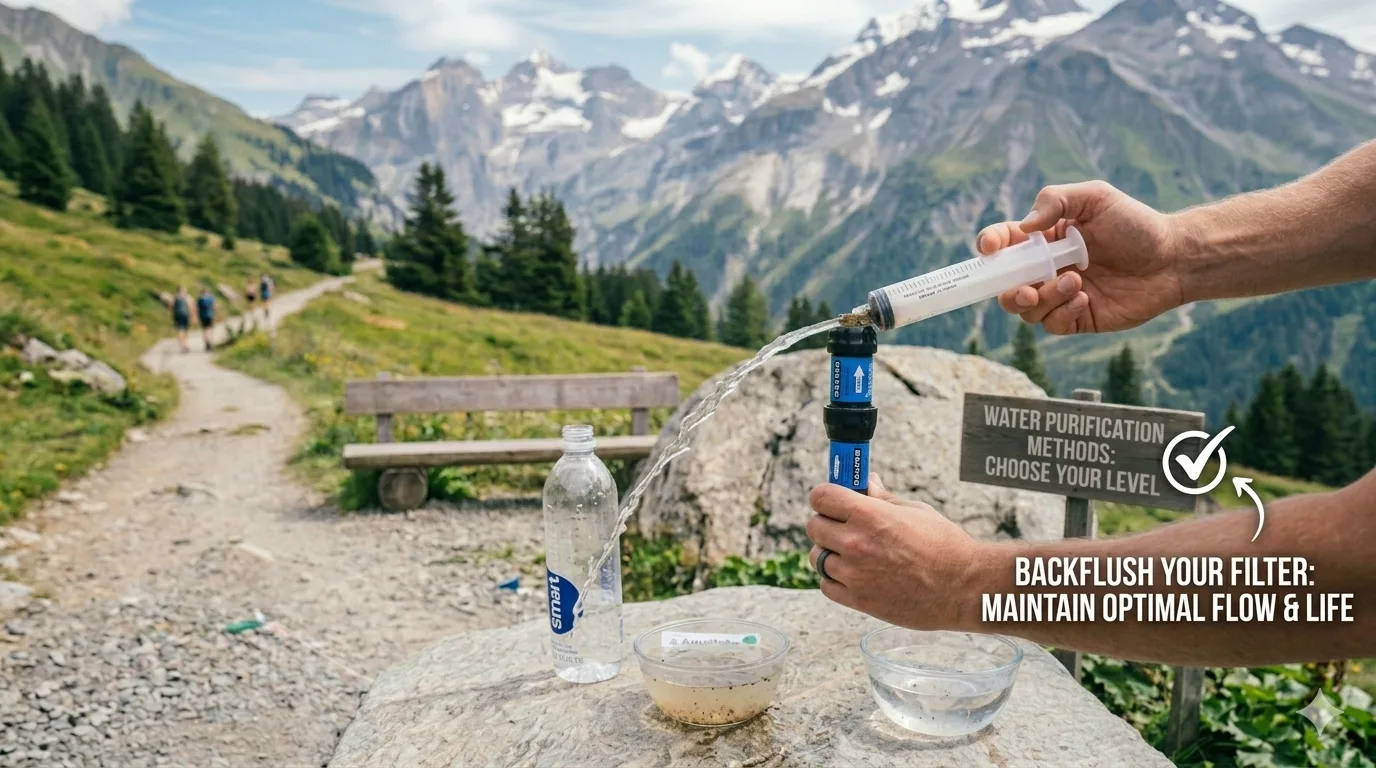
Read the manufacturer’s instructions before your first use and prime the filter if required. Keep the intake hose off the bottom of the source to avoid drawing in sediment. Pump or squeeze steadily rather than forcing it, and backflush or clean the filter regularly — a slow flow rate is the first sign that it needs attention. Always filter enough water for both drinking and cooking before you stop for the day.
Using Chemical Tablets
Add the correct number of tablets for your water volume, shake the container to dissolve them, and then wait the full treatment time printed on the packaging before drinking. Cold water requires a longer wait — if you are treating near-freezing water, extend the time accordingly. After waiting, loosen the lid and shake so the treated water contacts the threads and seal, which are easy to overlook. You can add a flavor enhancer after the full wait time if the taste is a concern.
Using a UV Purifier
Pre-filter any cloudy water before treatment, then insert the device and stir continuously for the full treatment cycle — usually 60 to 90 seconds. Watch for the completion signal before stopping. Keep a set of spare batteries in your kit, since a UV purifier with a dead battery is useless and cannot be improvised around.
Water Quantity Planning on the Trail
Knowing how much water you need and where to find it is as important as having the right purification gear.
Trekkers need a minimum of 3 to 4 liters of drinking water per day — more in hot conditions or at altitude. Add another 1 to 2 liters per day for cooking meals and basic camp tasks, bringing the total daily requirement to 4 to 6 liters. To manage pack weight, carry 2 to 3 liters between known water sources rather than loading up at every opportunity.
Before any multi-day trek, study your route map for streams, lakes, and springs and mark their locations. Read recent trip reports — water availability changes seasonally, and a stream that flows in spring may be dry by late summer. Note that snow melt provides abundant water in spring but requires extra fuel to treat by boiling if you lack another method.
Maintenance and Care of Your Purification System
A well-maintained system is a reliable system. In the field, rinse and dry your filter each evening, keep clean and dirty water containers strictly separate, and store chemical tablets in a dry sealed container away from heat. In freezing conditions, keep your filter inside your jacket or sleeping bag — a frozen filter element can crack and fail silently, giving you false confidence in compromised water.
After each trek, clean your filter thoroughly according to the manufacturer’s instructions and dry it completely before storage. A damp filter stored in a bag will grow mold. Check for visible damage, confirm tablets are within their expiration date, and test the full system at home before your next trip. Replace filter elements at the recommended intervals regardless of whether the flow rate seems fine — worn elements may not filter reliably even when they still pass water.
Backup Plans and Emergency Water Purification
Every trekker should have a contingency when their primary purification system fails. The standard setup is a primary filter or UV purifier combined with chemical tablets as backup. If your filter breaks, boil all drinking and cooking water using your stove until you reach a resupply point. If your UV device fails, switch to chemical tablets. If both fail, boiling is always available as a last resort provided you have fuel.
The decision to cut a trek short is also always on the table. Drinking untreated water is never worth the risk — the health consequences of waterborne illness in a remote location, far from medical care, are serious and long-lasting. A shortened trip is recoverable. A week of Giardia symptoms is not.
Learn about other essential gear in our guide on trekking backpack size guide.
Water Purification in Special Trekking Conditions
Winter and Freezing Conditions
Filters are vulnerable to freezing — a frozen filter element can crack internally and fail without any visible sign of damage. In winter, keep your filter inside your jacket or sleeping bag at night and during rest breaks. Chemical tablets are the most reliable option in cold conditions since they work at any temperature, though treatment time increases with colder water. If you need to melt snow for water, note that this requires significant fuel and you should still treat it — melted snow is not automatically safe.
Desert Trekking
Water sources in desert terrain can be scarce, far apart, and sometimes stagnant in tanks or potholes. Carry maximum water capacity between known sources and plan your daily distances around water locations rather than mileage alone. Stagnant water often carries higher contamination loads, so extra chemical treatment or a full purifier approach is recommended over a filter alone.
High-Altitude Trekking
At altitude, drink more water than you think you need since dehydration accelerates the effects of altitude sickness. The practical change for purification is boiling time — the boiling point drops with elevation, so water at 6,500 feet or above must boil for three minutes rather than one. UV purifiers and chemical tablets work normally at any altitude.
Water Purification System Cost Guide
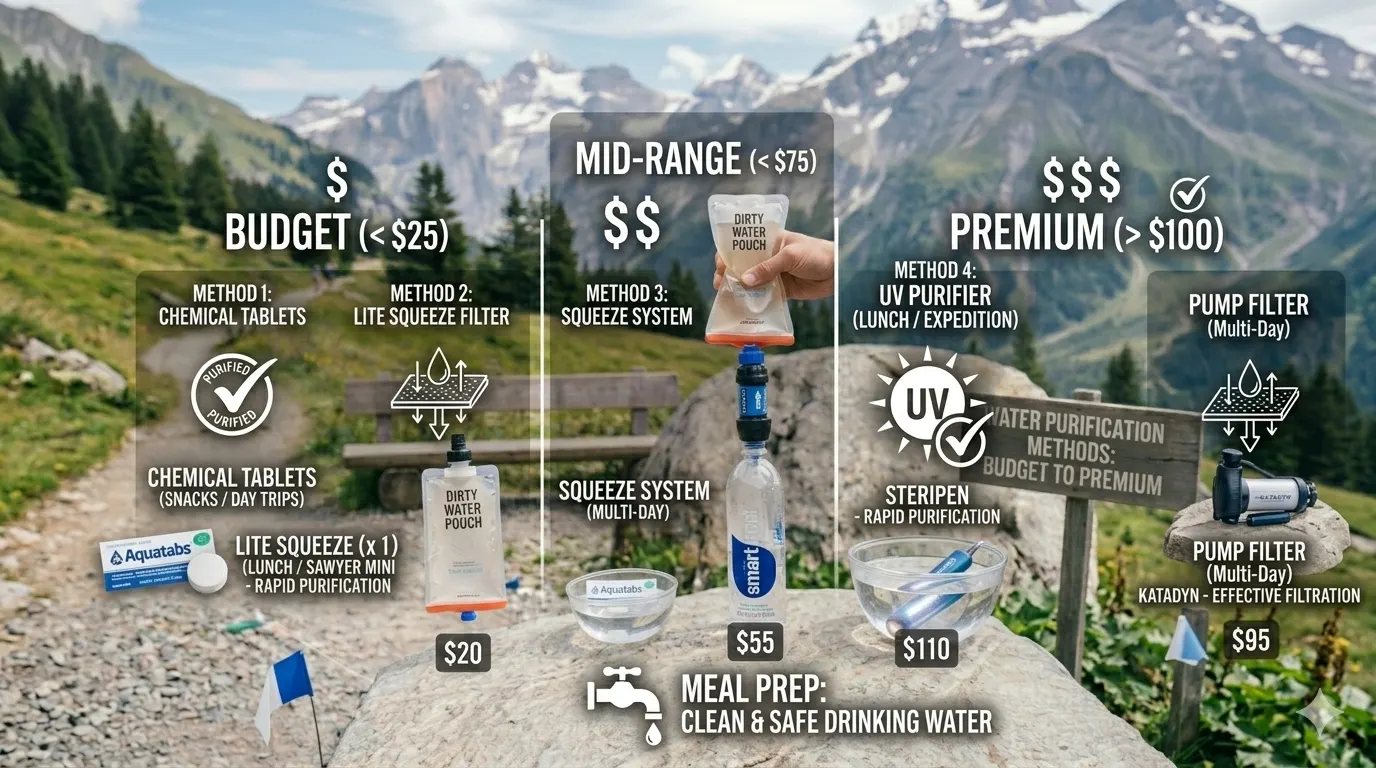
Effective water purification for trekking is available at every budget level. Here is how the main options compare by price range.
| Budget Tier | Price Range | Examples | Best For |
|---|---|---|---|
| Budget | $15 – $40 | Chemical tablets, basic straw filters, simple squeeze filters | Occasional trekkers, backup use |
| Mid-range | $40 – $100 | Quality squeeze and gravity filters, UV purifiers, pump filters | Regular trekkers — best value tier |
| Premium | $100+ | Advanced pump systems, large-capacity gravity filters, integrated filtration bottles | Frequent or international use |
For complete food and water planning guidance, read our article on trekking food planning guide.
Common Water Purification Mistakes to Avoid
Most waterborne illness on trek comes down to a handful of repeatable errors. The most common is not waiting the full chemical treatment time — cutting it short by even a few minutes leaves organisms alive. Assuming clear water is safe is the second most dangerous habit, and one that catches experienced trekkers off guard as often as beginners.
Cross-contamination is subtler but equally risky: touching the clean water outlet of your filter with dirty hands, failing to treat the threads and lid of your water bottle after chemical treatment, or rinsing clean dishes with untreated water can all reintroduce pathogens after purification. Using expired tablets is another common oversight — check dates before every trip, not after you reach the trailhead. Finally, never leave home without testing your system first. A filter you have not used in a year may be clogged, cracked, or simply confusing to operate under pressure.
Conclusion
Water purification for trekking is not optional — it is one of the most fundamental safety practices for any multi-day hike that requires refilling from natural sources. Choose a method that fits your trip: filters for convenience and speed, chemical tablets for lightweight backup, UV purifiers for technology-forward simplicity, or boiling when all else fails. Always carry at least two methods, know your water sources in advance, and treat every drop regardless of how clean it looks. With the right system and the right habits, waterborne illness is entirely preventable.
Ready to choose your water purification system? Research options for your next trek, purchase both a primary and a backup method, and practice using them at home before you hit the trail.
Frequently Asked Questions About Water Purification for Trekking
Can I just drink from high-altitude streams that look clean?
No. Even pristine-looking alpine streams can contain Giardia and other parasites. Animals defecate upstream from where you collect, and microscopic organisms are completely invisible to the naked eye. The remote location does not guarantee safety — in fact, wildlife concentrations near water sources increase contamination risk. Many experienced trekkers have gotten sick from beautiful mountain streams they assumed were pure. Always treat water regardless of appearance, elevation, or how untouched the area seems. The small effort is worth avoiding illness that can strike weeks after exposure and last for weeks more.
How do I know which water purification method removes viruses?
Standard filters remove bacteria and parasites but not viruses. To remove viruses you need chemical treatment (chlorine dioxide is the most effective), UV purification, or boiling. In North America, viruses in wilderness water are rare, so filters alone usually suffice. For international trekking — especially in developing regions — always use a method that kills viruses. Read product specifications carefully: “purifier” indicates virus removal, while “filter” typically does not. When in doubt, combine a filter with chemical tablets for protection against the full spectrum of threats.
What should I do if my water filter breaks mid-trek?
This is exactly why you carry backup chemical tablets and know how to boil water. If your filter fails, switch immediately to boiling all drinking and cooking water — bring it to a rolling boil for one minute at most elevations, or three minutes above 6,500 feet. If you have chemical tablets, use those according to package directions and wait the full treatment time. If neither option is workable, consider shortening your trek and returning to civilization. Never drink untreated water as an alternative — the health risks far outweigh the inconvenience of any other option.
Do I need to treat water for cooking pasta or making coffee?
If you are bringing water to a full boil, you are automatically treating it — boiling kills all waterborne pathogens, so pasta, rice, and hot beverages are safe to prepare with untreated water. However, for cold drinks, no-cook meal rehydration, brushing teeth, or rinsing dishes after washing, always use treated water. A common and costly mistake is rinsing clean dishes with untreated water, which recontaminates them. When in doubt, treat it. The only reliably safe untreated use is water that will reach a full boil during cooking.


No comments yet. Be the first to share your thoughts.